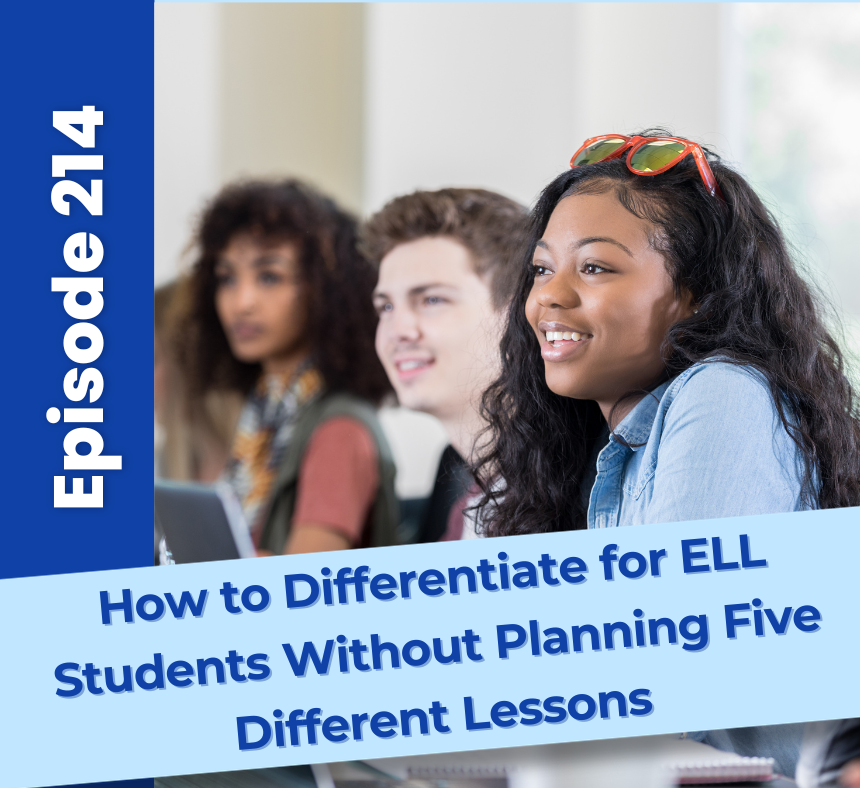
If there is one question ELL teachers ask more than any other, it is this one: how do I differentiate for students at completely different language levels without planning something different for every single one?
The honest answer is that most teachers are making differentiation much harder than it needs to be. And today’s episode gives you a framework that makes it manageable — starting this week.
What You Will Learn in This Episode
- The differentiation myth that is burning ELL teachers out — and the reframe that changes everything
- Why differentiation for ELL students means different ACCESS, not different content
- The three things you actually differentiate — and the one thing that stays the same for everyone
- How to group your students for differentiation without creating more work
- A complete lesson example with three entry points for three groups — same content standard, one planning session
- What you should NEVER differentiate — and why watering down content limits your students
- The three planning questions that make differentiation automatic over time
- A free resource to make this immediately usable in any classroom
The Myth That Is Making Differentiation Exhausting
Most teachers hear differentiation and think: different tasks, different texts, different worksheets, different everything for different students. And if that is the working definition, burnout is not a surprise — because that version of differentiation is not a teaching practice. It is an unsustainable workload.
Here is the reframe that changes everything.
Differentiation for ELL students does not mean different content. It means different access.
Your students — at every language level — can engage with the same concept, the same text, the same mathematical idea, the same science phenomenon. Their intellectual capacity is not in question. What differs is the language they need to access the content and the language they are able to produce to demonstrate they understood it.
When you differentiate access, not content, you plan one lesson with multiple entry points. That is achievable. That is sustainable. And that is what actually supports language acquisition.
The Three Things You Actually Differentiate
Just three. Everything else stays the same.
1. The Scaffold
The content objective is the same for everyone. The task is the same. But the scaffold — the sentence frame, the graphic organizer, the visual support, the level of modeling — adjusts by language stage.
Level 2 students get a complete sentence frame. Level 3 students get a partial frame. Level 4 students get a complex frame that pushes academic language. Level 5 students may need only a sentence starter or nothing at all.
Same task. Same concept. Different scaffolding.
2. The Language Objective
Everyone works toward the same content objective. But the language objective — what students will do with language to demonstrate that understanding — adjusts by level.
Level 2: students will use sequence words first, then, and finally to name the stages of the water cycle.
Level 3: students will explain one stage of the water cycle using a cause and effect structure.
Level 4: students will describe the relationship between two stages using academic vocabulary and comparative language.
Same content. Different language targets. Different entry points into the same learning.
3. The Output
How students demonstrate understanding can vary without the content varying.
Level 1: point, draw, or gesture.
Level 2: label a diagram or complete a sentence frame orally.
Level 3: write a short paragraph.
Level 4: write a comparative response with claim, evidence, and explanation.
The concept being assessed is the same. The language demand of the demonstration adjusts to where each student actually is.
Planning for Groups, Not Individuals
You are not making these three decisions for thirty individual students. You are making them for three groups.
Look at your students through the lens of what support they actually need right now. You will almost always find three natural clusters.
Group A needs heavy scaffolding — complete frames, lots of visual support, strong modeling, very structured output.
Group B needs moderate scaffolding — partial frames, graphic organizers, some visual support, more independence in output.
Group C needs light scaffolding — complex frames that push academic language, more organizational independence, higher demand output.
Three groups. Three sets of decisions. One lesson.
A Real Lesson Walked Through
Content: fifth grade science on decomposers. Content objective for everyone: students will understand the role of decomposers in the ecosystem.
Group A — Level 1 and 2: language objective is to name and point to decomposers in the food chain diagram. Scaffold: labeled diagram, picture vocabulary cards, simple frame — Decomposers break down ___. Output: label the diagram and complete the frame orally with a partner.
Group B — Level 3: language objective is to explain what decomposers do using a cause and effect structure. Scaffold: partially labeled diagram, vocabulary bank, frame — Decomposers break down ___, which causes ___, because ___. Output: written response, two to three sentences.
Group C — Level 4 and 5: language objective is to evaluate the importance of decomposers using academic language and evidence from the text. Scaffold: complex sentence starter — Without decomposers, ecosystems would ___ because ___. Output: written paragraph with claim, evidence, and explanation.
Same content standard. Three entry points. One planning session.
What You Should Never Differentiate
Three things that must stay consistent for every student in the room.
The content. ELL students deserve access to grade-level ideas and the same intellectual work as their English-proficient peers. Giving them a simpler version of the content is not support — it is a ceiling. Do not limit them.
The expectation for thinking. Level 2 students can analyze, compare, evaluate, and predict. They can perform every cognitive task in Bloom’s Taxonomy. The support you provide is for the language, not the thinking.
The sense of belonging. Every student should feel like they are doing the same work as their peers. The scaffolding is present without singling anyone out or signaling that they are on a different track. This matters enormously for the affective filter. When students feel like they have been given the easy version, confidence disappears — and so does acquisition.
Three Planning Questions to Make This Automatic
Before finalizing any lesson, ask:
What is the language function of this task? Explain, compare, justify, describe — this anchors the language objective.
What scaffold does each group need to do that function at their level? What frame, organizer, or visual gets each group across the bridge?
How will each group show me they understood? What does output look like for each entry point?
Three questions. Fifteen minutes. One lesson that reaches everyone. And the more you practice, the faster it becomes — until it is not something you consciously do. It is just how you design instruction.
Your Free Go-To Guide for Teaching ELLs
DM the word GUIDE to @EquippingELLs on Instagram for the free Go-To Guide for Teaching ELLs — practical differentiation tips, entry point examples, and scaffolding tools for every level.