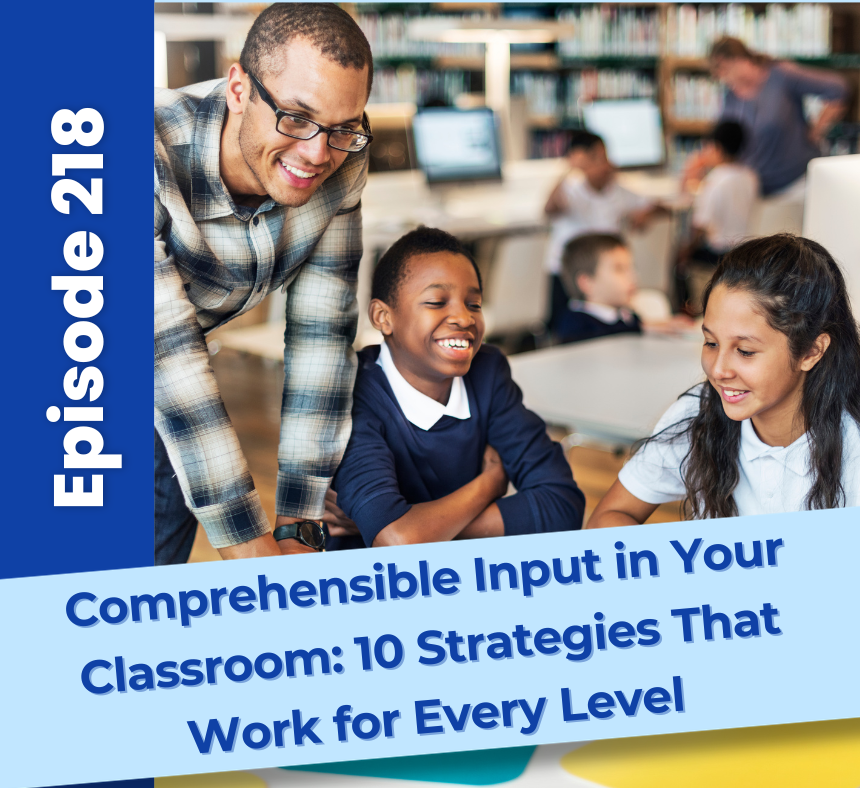
If you listened to Episode 206 you already understand why comprehensible input matters. This episode is about what it actually looks like on a Tuesday afternoon in your classroom with students at four different language levels.
Ten strategies. Every one of them something you can start using this week.
The Anchor Thought
Comprehensible input is not about making things easier. It is about removing the language barrier so students can access the thinking. ELL students are intellectually capable of engaging with grade-level content. The challenge is not the content — it is the language used to deliver it. Every strategy below is designed to take that barrier down enough that students can get to the idea.
Strategy 1 — Slow Your Rate of Speech and Leave Silence
Native English speakers speak at approximately 150 words per minute. For a student actively decoding a new language that rate is overwhelming. Slow down. Leave pauses after key ideas. Speak in shorter sentences with the same academic vocabulary — not dumbed-down language, just shorter. The pause is where processing happens. If you fill every pause with more words you take away the moment where input becomes comprehensible. Practical check: record yourself teaching for three minutes and play it back.
Strategy 2 — Pre-Teach Vocabulary Before the Lesson — Not During It
When students encounter an unknown word mid-lesson their brain stops — and the next three sentences are lost. Pre-teach five to eight essential words before the lesson begins. A quick visual introduction with a student-friendly definition, an example, and a personal connection. When those words appear in the lesson they are already in the student’s brain and the lesson becomes comprehensible.
Strategy 3 — Use Visuals That Carry Meaning — Not Decoration
A picture of an ecosystem labeled with key vocabulary is comprehensible input. A stock photo of the ocean on a slide about ecosystems is decoration. Ask yourself about every visual: does this reduce cognitive load? Does it give students a way into the concept even if the words are not fully accessible? For newcomers and Stage 1 and 2 students visuals are not supplemental — they are the primary access point.
Strategy 4 — Chunk Instruction with Processing Time
By minute eight of a twenty-minute explanation most ELL students have stopped comprehending. Chunk instead. Teach for two to three minutes. Stop. Give students thirty seconds to think, whisper to a partner, jot a word or phrase. Then teach for two to three more minutes. Stop again. The processing moment is not a break from learning — it is where input becomes comprehensible. Skip it and you skip the acquisition.
Strategy 5 — Use Gestures and Physical Demonstrations
Physical demonstration paired with language is one of the most powerful forms of comprehensible input available — especially for newcomers and Stage 1 and 2 students. Stand up. Pick up the object. Act it out. Use your hands to show size, direction, relationship. When you gesture consistently with specific vocabulary you build a physical vocabulary that makes language comprehensible even when words alone would not be. Total Physical Response is built entirely on this principle.
Strategy 6 — Model Your Thinking Out Loud
When you model a task by doing it yourself out loud — including confusion, self-correction, and uncertainty — you provide comprehensible input for the task itself. Students hear academic language used purposefully in context to accomplish something. Make a mistake on purpose and correct yourself out loud. Narrate every step. You are not giving away the answer. You are showing students how language is used to think.
Strategy 7 — Partner Students Strategically for Structured Interaction
Free conversation between a Level 2 and Level 4 student results in the Level 4 student doing all the talking. Structured partner talk with a specific prompt and a sentence frame creates the conditions where the less proficient student receives comprehensible input from their partner — language just one level above their own in a low-stakes context. Pair Level 1 with Level 2. Level 2 with Level 3. The goal is a just-right model, not a task-completer.
Strategy 8 — Use Sentence Frames as Comprehensible Input — Not Just Output
This reframe is important. When a student sees a frame on the board — The character decided to ___ because ___ — they are receiving a model of how academic English organizes a cause-and-effect explanation. The frame makes the language structure visible and comprehensible before students have to produce it. Post frames visibly. Leave them up. Use them in your own modeling. Let students encounter the structure repeatedly in multiple contexts until it internalizes.
Strategy 9 — Activate Prior Knowledge in Any Language
When students have a schema for a topic new input has something to connect to. When they do not it has no anchor. Before every new concept spend a few minutes activating what students already know — in any language. Ask a student what they know about ecosystems in Spanish. Have them draw what they understand before you teach it in English. Schema is schema. The activation does not have to happen in English to make English input comprehensible.
Strategy 10 — Use Short Audio and Video Clips Purposefully
A well-chosen two to three minute video provides comprehensible input through visual, auditory, and contextual channels simultaneously. The key word is purposefully. Without structure it is entertainment. With structure it is comprehensible input. Before the clip: pre-teach two or three key words and give students one specific thing to listen or watch for. After: a sentence frame to respond — I noticed that ___. This shows that ___.
The Question That Makes This a Habit
You are probably already doing some of these. The question is not whether any single strategy is present in your lessons. The question is whether comprehensible input is a consistent design principle — whether you ask before every lesson: have I removed the language barriers enough that every student in this room can get to the idea? When that is your planning anchor, comprehensible input stops being a checklist and starts being a teaching instinct.
Start with one strategy this week. Add others over time. Build them into your routines until they become automatic.
Related Episodes: EP206 — What Second Language Acquisition Actually Means for Your Classroom EP209 — What Is Sheltered Instruction and Are Your ELLs Actually Getting It? EP213 — Sentence Frames for ELL Students: The Scaffold That Changes Everything