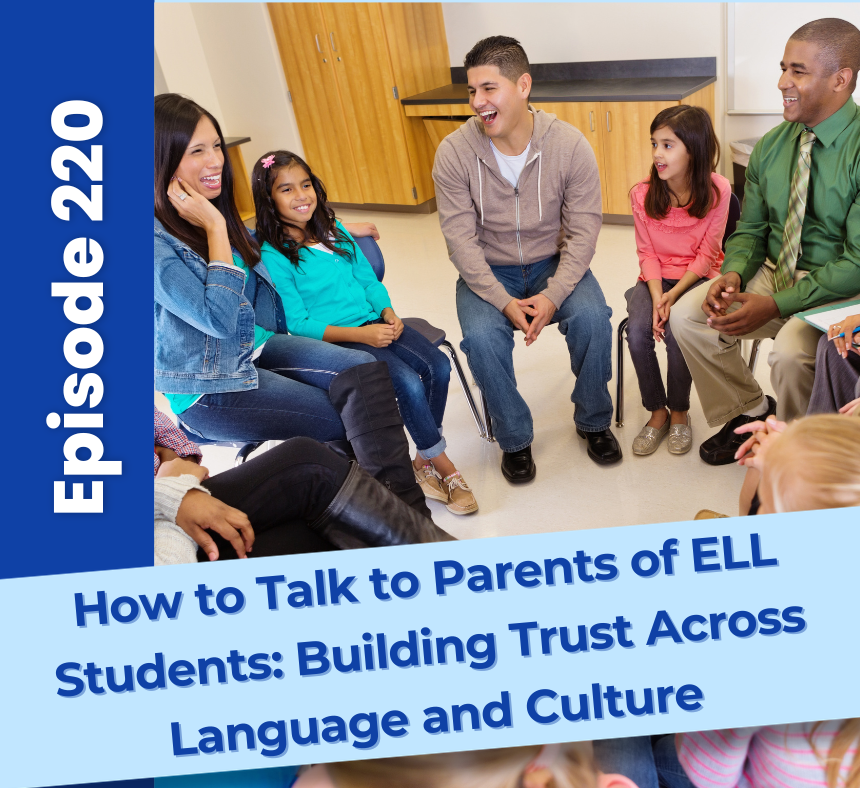
Imagine you are a parent. You moved to a new country less than a year ago. You walk into a school building where you cannot fully understand what anyone says, where you receive paperwork in a language you cannot read, where you leave a conference not knowing what just happened or whether your child is okay.
That is the experience of parent communication from the other side of the table. And holding that experience in mind changes everything about how you approach it.
What You Will Learn in This Episode
- Why ELL parent communication carries unique complexity beyond just language
- The difference between cultural humility and cultural competence — and why it matters
- Why building the relationship before you need it changes every hard conversation later
- Five proactive strategies for reaching ELL families across language and culture
- Three practical communication modes and when to use each
- What to never do — including a direct word about using students as interpreters
- Why the home language is not a barrier but an asset — and what to tell parents who ask
- A free About Me template that makes the first contact easy and translatable
The Three Layers of Complexity
Language is the most obvious barrier. Communication that takes two minutes with an English-speaking family might take twenty with an ELL family — or might not happen at all without intentional support.
But language is not the only barrier.
Culture shapes how families understand the role of teachers and parents in education. In some cultures a parent questioning a teacher is deeply disrespectful — so when you invite parents to share concerns, they may not, even when concerns exist. In others, deep parental involvement is expected and parents feel hurt when it is not happening. There is no single cultural norm, and assuming your way is the default creates distance before you say a word.
Then there is trust. Some families have very good reasons to be cautious about institutions — because of immigration status, past trauma, or difficult experiences with authority. A parent who does not respond is not necessarily disengaged. They may be working three jobs, afraid, or simply unable to navigate a system nothing in their background prepared them for.
Honest is where trust begins.
Cultural Humility First
Cultural competence suggests you can learn enough about a culture to be proficient in it. Cultural humility says something different: I do not know everything about this family’s experience. I come to this relationship as a learner as much as an expert.
When a parent does something you do not understand — does not show up, does not return a form — get curious before you label it as disengagement. Is there a language barrier? A cultural reason? Something about their life circumstances you do not know? Ask gently and without judgment. The answer often changes what you do next.
Build the Relationship Before You Need It
Do not wait until there is a problem to make meaningful contact. The first interaction should not be a form requiring a signature or a concern requiring a meeting. Be a person first. Small, consistent, warm communication that says I see your child, I know your child, and they are welcome here builds the foundation that makes every harder conversation later feel safer.
Five Proactive Strategies
1. Learn something in their home language. Even a few words — hello, thank you, your child is doing well. An imperfect attempt communicates more than any formal letter. You become a person who is trying, not just an authority figure to navigate.
2. Use translation apps as a bridge, not a last resort. TalkingPoints provides real-time two-way text conversations in families’ home languages. A voice message through a translation app saying your son tried something new today and I was proud of him crosses the language barrier in seconds. Families who never respond to English emails often respond to a message in their language — because now they actually know what it says.
3. Send visible artifacts before written communication. A photo of a student working on something they are proud of, a writing sample from September next to one from today — these communicate across language. Parents do not need to read English to see their child’s writing has changed. They do not need an interpreter to feel proud of a photo.
4. Introduce yourself before anything is expected. Do not let the first thing a family receives be a form to sign. Send something that says who you are, what you notice about their child, and how to reach you — in a format they can actually read.
5. Lower the threshold for what counts as connection. A wave at drop-off. A thumbs up through the classroom window. A sticky note in a folder. Small consistent signals that say I see you and your child is welcome here build something real over time.
Three Communication Modes
Written translation tools work well for routine communication — permission slips, newsletters, announcements. Google Translate and TalkingPoints are both useful. Important: anything related to special education, legal rights, or discipline must be reviewed by a qualified bilingual person before going home.
Interpreter-supported conversations are required for any meaningful discussion — conferences, progress meetings, service explanations. Never use a student as the interpreter for conversations about that student. A nine-year-old should not be explaining to their parent that they are struggling in school. That conversation deserves an adult. Ask your district about interpreter services.
Informal check-ins are sometimes the most powerful of all. The casual greeting at drop-off. The quick translation-app message after a good day. These are not about information transfer — they are about relationship. And they are what make formal meetings feel safe when you need them.
Three Things to Never Do
Never use a student as interpreter for meaningful conversations about that student. Never send home paperwork in a language families cannot read and expect meaningful engagement — simplify, translate, follow up. Never assume a parent who does not show up does not care. Find another way to reach them.
Home Language Is an Asset
Research consistently shows that students with a strong foundation in their home language acquire English faster and perform better academically long-term. When parents ask whether to stop speaking their language at home — the answer is no. Keep it alive. Read together. Tell stories. Sing songs. That is not competing with English acquisition. It is accelerating it.
Your Free About Me Template
DM the word FAMILY to @EquippingELLs on Instagram for a free editable About Me template in Canva — warm, simple, beautifully designed, and translatable into any language in seconds. Send it home in the first week of school so parents know your name, what you notice about their child, and how to reach you — before anything else is ever expected of them.
Related Episodes: EP219 — How to Co-Teach With General Education Teachers to Actually Support Your ELLs EP222 — How to Be the ELL Expert in Your Building Even When Nobody Listens